 interest in the East was
awakened by the crusades, the series of military expeditions undertaken by the Christian
European countries against Muslim Arab countries during the 11th, 12th and 13th centuries.
At the time there were ready markets in Europe for gold, silver, precious stones, spices,
carpets and fabrics.
interest in the East was
awakened by the crusades, the series of military expeditions undertaken by the Christian
European countries against Muslim Arab countries during the 11th, 12th and 13th centuries.
At the time there were ready markets in Europe for gold, silver, precious stones, spices,
carpets and fabrics.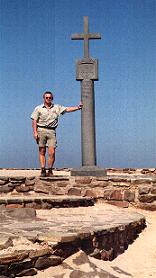
The sea traffic from India was controlled by Arabs. They also explored the coast of East Africa, trading cloths and porcelain for gold, slaves and ivory. It is likely that Arabs suspected about existence of a sea route around Africa.
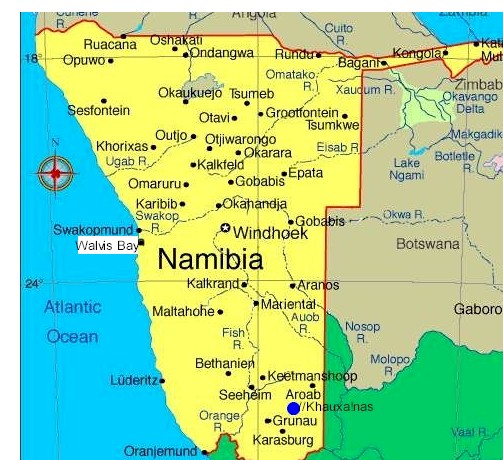
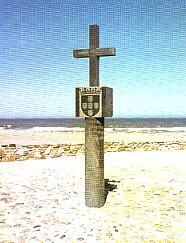
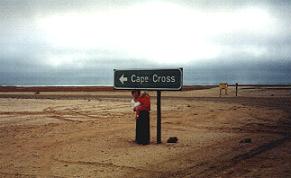
The Portuguese wanted to bring glory to their country. The bulk of the trade to Europe was controlled by the Muslims and merchants of the northern Italy and for the Portuguese to increase their share of the trade a direct sea route to the Indies had to be found. King Johan 2 chose captain Diego Cao who sailed in 1482 to the Congo river where for the first time he erected not a wooden cross but a padrao carved in stone. The padrao was a stone cross serving as a symbol of Christianity and Portuguese possession. Another padrao was erected in Angola which became a Portuguese colony for the next 400 years. Diego Cao had an impressions that he found the tip of Africa. Within two years he sailed out again and erected a padrao at Cape Cross in present Namibia. He sailed further south to an unidentified ''grey mountain'' and died there.
Bartholomias Dias was the head of the next expedition. Dias' navigators were well trained and had the latest scientific instruments. They sailed to a bay in Angola and then to today's Walvis Bay. Covering about 50 km per day they had to struggle with strong winds. Dias ordered the course to be changed. They now had a powerful wind behind them and Dias suspected that they had sailed beyond the Cape. They landed at today's Mossel Bay where they found fresh water. In a conflict with Khoikhoi the Portuguese killed one of them. The sailors were exhausted and Dias decided to return home. Only on their way back they saw the Cape Peninsula, which Dias named ''Cape of Good Hope''.
The padrao was erected (it had never been found). Another padrao was raised at today's Luderitz. Dias proved that a feasible sea route to India did exist. When he returned home in 1488 his reward, however, were not great as he had failed to carry out the King's orders fully. He died 12 years later.
In 1497 Vasco da Gama's fl
 eet set a far course out into the Atlantic and then taking
advantage of the winds which carried them back to Africa. The route he took is still the
recommended one today for sailing vessels. Da Gama made his landfall north of St Helena
Bay, where he stayed for eight days while his men gathered firewood and collected water
from the Berg river. Here they found a single Khoikhoi man collecting honey. One of the
seamen was allowed to accompany the Khoikhoi to their village to observe their way of
life. When he called to be taken back to the ship the Portuguese thought he was shouting
to be rescued and fighting broke out between them and the Khoikhoi. Da Gama himself was
among the few Portuguese who were wounded.
eet set a far course out into the Atlantic and then taking
advantage of the winds which carried them back to Africa. The route he took is still the
recommended one today for sailing vessels. Da Gama made his landfall north of St Helena
Bay, where he stayed for eight days while his men gathered firewood and collected water
from the Berg river. Here they found a single Khoikhoi man collecting honey. One of the
seamen was allowed to accompany the Khoikhoi to their village to observe their way of
life. When he called to be taken back to the ship the Portuguese thought he was shouting
to be rescued and fighting broke out between them and the Khoikhoi. Da Gama himself was
among the few Portuguese who were wounded.At Malindi, north of Mombassa, Da Gama was able to engage an experienced Arab navigator, who guided them across the Indian ocean to the Indian port of Calicut. At last the door was fully open, the destination reached! On the return voyage many men died of scurvy, including Da Gama's brother Paulo Da Gama. Unlike Dias, Da Gama was welcomed home as a hero.
The greatest tribute to the explorers of this era stands in Lisbon. It is called the ''Monument of Discoveries'' erected in appreciation of the courage of those first navigators to travel the sea route to the East.