Swakopmund, Namibia, was founded two years later than Windhoek, in 1892, by Captain Curt von
Francois as the main harbour of German South West Africa. Increased traffic between
Germany and its colony necessitated establishing of own port as Walvis Bay, located 33
kilometres south, was already in British possession. The choice fell on Swakopmund where
water could be found and because other sites checked (including Cape Cross) were
unsuitable.
Name. The majority of towns and villages in Namibia have grown out of indigenous
settlements and very often were located close to sources of water. Names of places given
by original inhabitants were very descriptive and in many cases those names were retained
by European settles who sometimes simplified pronunciations of the names.
Nama word
''Tsoakhaub'' can be translated as ''excrement opening'' which was offensive but accurate
description of the waters of Swakop River at the time of coming down in floods carrying
masses of mud, sand, pieces of vegetation and animal corpses. The masses of dirty and
muddy water were emptied into the ocean and the indigenous name described it very well.
Swakopmund is one of the most
beautiful and most loved holiday town in Namibia. Only three hours of driving
from Windhoek - and you are away from heat and busy city life, enjoying ocean
and waves. The town is a home to a plenty of tours and activities. It is the
gate to Skeleton Coast Park as well as for Dorob National Park.
The Nama name was changed to ''Swachaub'' and with proclamation of Swakopmund as
independent district in 1896 the present way of writing came into use.
YouTube video of Mondesa tour -
Swakopmund, Namibia:
History
On 4 of August 1892 the crew of gunboat ''Hyena'' erected two beacons (one
at the present location of the Mole and another at the location of lighthouse) to mark the
landing site which symbolized the laying of the foundation stone of the town. The first
settlers were offloaded from the ''Marie Woermann'' (120
Schutztruppe with equipment and 40 settlers) using 4 landing boats. The settlers had to
build a ''caves'' on the beach to protect themselves against hostile weather. Before the
Mole was built all offloads were carried with use of special boats which can be handled by
Kroo (Kru) men (from Liberia) only. At the time up to 600 Kroo tribesmen were employed by Woermann Line. The number of vessels offloaded in Swakopmund was
increasing rapidly. In 1894 four ships offloaded, 1895 - 5, 1896 - bi-monthly service was
introduced by Woermann Line, 1899 - monthly service.
First town building plan was drawn by Dr. Rhode. Because of lack of building
materials mainly prefabricated wooden houses were erected.
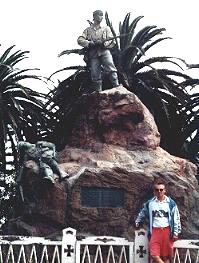
Design of Berlin sculptor Wolff,
donated to Swakopmund by marines from Kiel in 1908.
War memorial
Unveiled on 10 November 1963 in memory of those killed in
World War 2. Located near the museum.
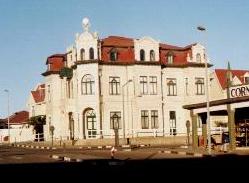
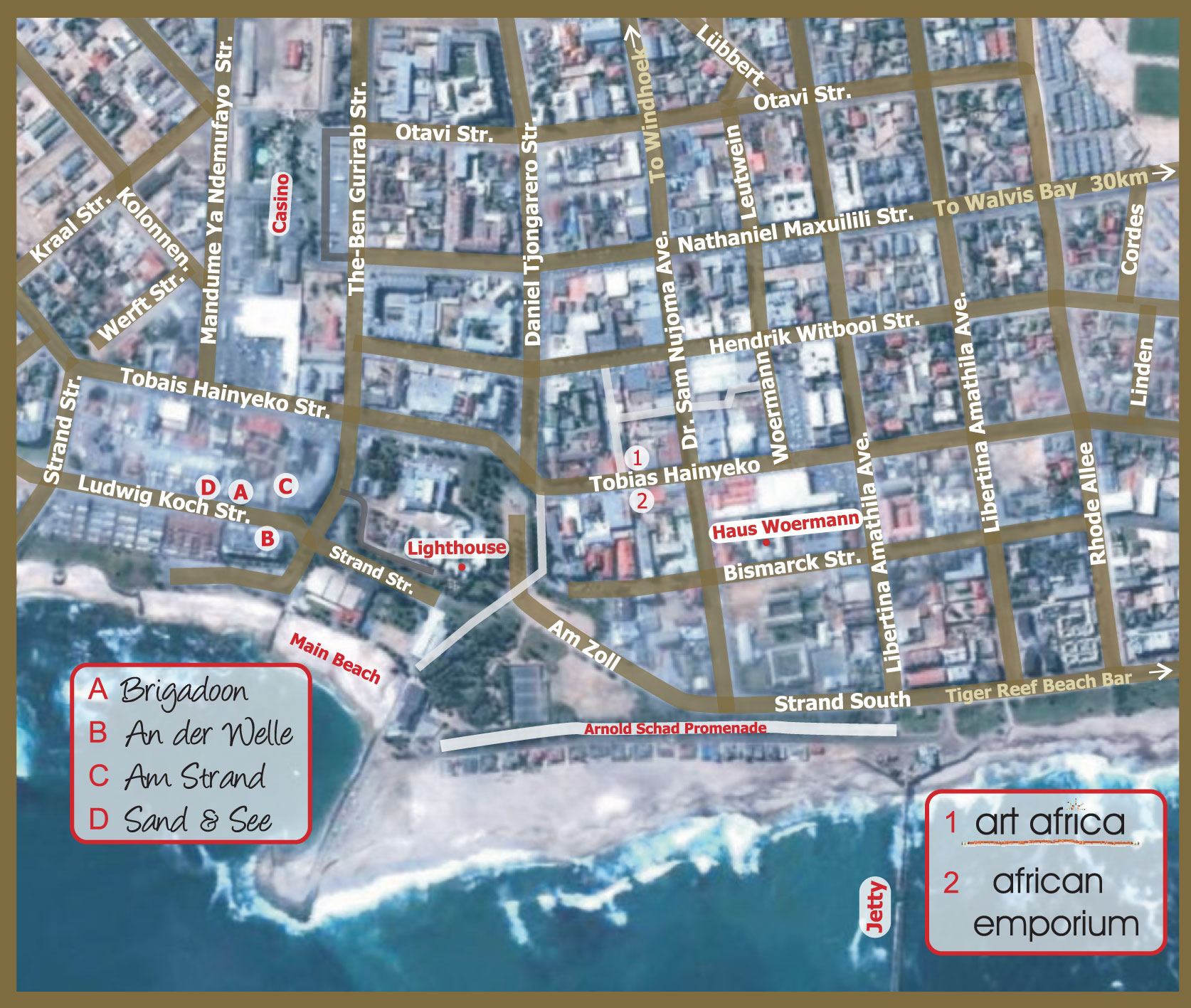
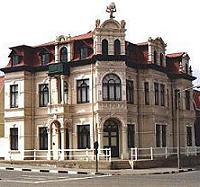
Woermann House. One of
the most beautiful buildings in the town was completed in 1905.
The Mole
An unsuccessful attempt to construct the artificial harbour. 375
metres pier was completed in 1900 but by winter 1906 a sandbank completely blocked it.
The first wooden jetty, completed in 1905, was damaged by borer worm Teredo
navalis and construction of iron jetty began in 1911. Proposed length of 640 metres
was enough to offload vessels without usage of smaller boats but by the beginning of World
War 1 only 262 meters were completed. First repairs were done in 1986 when first
part of iron poles were encased in concrete. The second
replacement of badly corroded iron structures and repairs (part of jetty was closed for pedestrians in
1998 for 7 years) were finalised in 2010, including wooden promenade. The Jetty
was proposed to be part of new desalination plant which in Swakopmund which
never materialised.
YouTube video of abandoned oil rig
near Toscanini, Skeleton Coast:
YouTube video of tour to Rossing uranium mine from Swakopmund:
Историческая
пристань в городе Свакопмунд в Намибии
Первая деревянная пристань, завершенная в 1905 году, была повреждена червем
Teredo navalis и строительство новой стальной конструкции началось в 1911 году.
Планировалась длина пристани в 640 метров, но к началу 1 мировой войны в 1914
были завершены только 262 метра. Первый ремонт был сделан в 1986 году с заменой
передних сильно проржавевших железных конструкций (позже второй
неремонтированный участок пристани был закрыт для пешеходов в 1998 году на 7 лет),
второй был завершен в 2010 году и открыт ресторан и суши бар с видом на
Атлантический океан.
YouTube video of tour to Mondesa |
Township singers Vocal Galore | Swakopmund:
Princess Rupprecht House
Now a private pension/B&B the original building was
completed in 1901 as a military hospital.
Kaserne
The original building served as a barracks. The design is similar
to Alte Feste in Windhoek and Fort Namutoni in Etosha Park and
the building was completed in 1906.
Railway station
(Swakopmund hotel from 1994). Declared a National monument
in 1972 the building, designed by C. Schmidt (tower design by Willy Sander - architect of
Windhoek's ''Three Castles''), was completed in 1901. German school. Completed in October 1913, the building hosted both the
government and municipal secondary schools. Design by E. Krause.
Built in 1906 and initially served as a hotel. At the present it is sectional title flats.
Deutsche Evangelical church
The building designed by Otto Ertl was
consecrated on 7 January 1912. The bells were imported from Germany where they were made
by Franz Schilling. The second oldest building in Swakopmund. Proclaimed
National Monument on 21 September 1978.
YouTube video of Swakop River made it into
the Atlantic ocean in 2022:
Antonius Gebaude
Designed by Otto Ertl the building (the hospital) was
opened in March 1908.
Swakopmund Lighthouse
First 11 metres were erected in July 1902 and further 10 meters
added in 1910.
State House (Kaiserliches Bezirksgericht)
Built as a magistrate's court in
1902 the building served as a summer residence for top government officials for several
decades. Architect C. Schmidt.
September 1892. First building is erected
in Swakopmund (a barrack for troops). 1894. 19 inhabitants. 1895. First people to be buried in the local cemetery - 5 sailors
who drowned in boat accident. 1896. Lieutenant Troost's attempts to solve transport problem by
introducing ''Martin Luther''. 1897. First post office in town. 1899. Introduction of cable telegraph service. Water pipeline from
Swakop. 1901. First passengers is landed at the Mole. Telephone service
established with 40 subscribers. 1903. First wooden pavements. 1905. Jetty opened. The newspaper Deutsche Suedwestafrikanische
Zeitung published. 1433 inhabitants. 1909. Swakopmund is an independent municipality. 1911. Shipping connection with New York. First Swakopmunder
Zeitung published. 1914. Shelling of the harbour by British naval cruisers.
Swakopmund is evacuated inland. 1915. Occupation by SA troops. Shooting
of more than 1500 horses and mules outside of the town. 1926. Railway bridge opened over the mouth of Swakop river. 1929. Hansa Brewery is opened.
Establishment of
Arnold Schad Promenade. 1930. First guano platform constructed. 1931. Railway bridge is destroyed by flood. 1935. Railway bridge constructed 5 km upstream from Swakop river
mouth. 1951. Opening of museum by Dr.
A. Weber. 1959. Opening of salt road to Walvis Bay. 1960. 4 701 inhabitants. 1967. Tar road from Windhoek reached Swakopmund. 1970. Tar road to Walvis Bay opened. 1973. First 3 traffic robots. 1982. 5 800 vehicles registered in town. 1994. Swakopmund Hotel is opened.
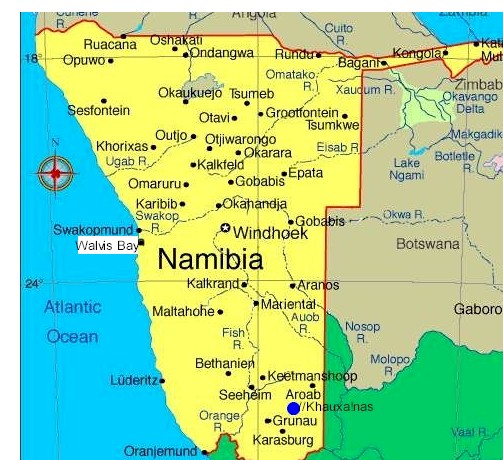
Swakopmund (German
for "Mouth of the Swakop") is a city on the coast of Namibia, 360 km west of
Windhoek, Namibia's capital. It is the capital of the Erongo administrative
district. The town has 42,000 inhabitants and covers 193 square kilometres (75
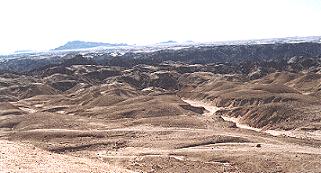
sq mi) of land. The city is situated in the Namib desert.
Swakopmund is a beach resort and an example of German colonial architecture. It
was founded in 1892 as the main harbour for German South-West Africa, and a
sizable part of its population is still German-speaking today.
The city lies on the B2 road and the Trans-Namib Railway from Windhoek to Walvis
Bay. It is also home to Swakopmund Airport.
Buildings in the city include the Altes Gefängnis prison, designed by Heinrich
Bause in 1909. The Woermann Haus, built in 1906 with a prominent tower, is now a
public library.
Attractions in Swakopmund include a Swakopmund Museum, the National Marine
Aquarium, a crystal gallery and spectacular sand dunes near Long Beach south of
the Swakop River. Outside of the city, the Rossmund Desert Golf Course is one of
only 5 all-grass desert golf courses in the world. Nearby lies a camel farm and
the Martin Luther steam locomotive, dating from 1896 and abandoned in the desert
due to breakdown.
The Herero called
the place Otjozondjii. The name of the town is derived from the Nama word
Tsoakhaub ("excrement opening") describing the Swakop River in flood carrying
items in its riverbed, including dead animals, into the Atlantic Ocean. The
German settlers changed it to Swachaub, and when in 1896 the district was
officially proclaimed, the version Swakopmund (German: Mouth of the Swakop) was
introduced.
History of
Swakopmund
Captain Curt von François founded Swakopmund in 1892 as the main harbour for the
Imperial German colony. The deep sea harbour at Walvis Bay belonged to the
British. The founding date was on August 8 when the crew of gunboat Hyäne
("Hyena") erected two beacons on the shore. Swakopmund was chosen for its
availability of fresh water, and because other sites further north such as Cape
Cross were found unsuitable. The site did, however, not offer any natural
protection to ships lying off the coast, a geographical feature not often found
along Namibia's coast.
When the first 120 Schutztruppe soldiers and 40 settlers were offloaded at
Swakopmund, they had to dig caves into the sand for shelter. The offloading was
done by Kru tribesmen from Liberia who used special boats. Woermann-Linie, the
operator of the shipping route to Germany, employed 600 Kru at that time.
Swakopmund quickly
became the main port for imports and exports for the whole territory, and was
one of six towns which received municipal status in 1909. Many government
offices for German South-West Africa had offices in Swakopmund.
Soon, the harbour created by the Mole silted up, and in 1905 work was started on
a wooden jetty, but in the long run this was inadequate. In 1914 construction of
a steel jetty was therefore commenced, the remains of which can still be seen
today. After World War I it became a pedestrian walkway. It was declared
structurally unsound and was closed to the public for seven years, and in 2006
renovations to the portion supported by concrete pillars were completed, with a
seafood restaurant and sushi bar being added to the end portion of the steel
portion of the jetty soon after. A new timber walkway was also added onto the
existing steel structure, and the steel portion of the jetty reopened to the
public in late 2010.
Woermann House &
Tower
One of the well-known
buildings in town.
Trading and shipping
companies founded branches in Swakopmund. A number of these buildings still
exist today. After German South-West Africa was taken over by the Union of South
Africa in 1915, all harbour activities were transferred from Swakopmund to
Walvis Bay. Many of the Central Government services ceased. Businesses closed
down, the number of inhabitants diminished, and the town became less prosperous.
However, the natural potential of Swakopmund as a holiday resort was recognised,
and this potential has subsequently been developed. Today tourism-related
services form an important part of the town's economy. The Swakopmund Skydiving
Club has operated from Swakopmund Airport since its founding in 1972.
Swakopmund Jetty
Landing jetty used to offload
goods into harbour.
The discovery of
uranium at Rössing, 70 km (43 mi) outside the town, led to the development of
the world's largest opencast uranium mine. This had an enormous impact on all
facets of life in Swakopmund which necessitated expansion of the infrastructure
of the town to make it into one of the most modern in Namibia.
After Namibian independence in 1990 many street names were changed from their
original German, or in some cases, Afrikaans names, to honor (mostly black)
Namibians. For example in 1991, then-president of Namibia Sam Nujoma renamed the
main street (Kaiser-Wilhelm-Straße) Sam Nujoma Avenue in honor of himself.
In October 2000 an agreement was signed between the Namibian and People's
Republic of China governments to build a satellite tracking station at
Swakopmund. Construction was completed in July 2001 at a site north of
Swakopmund to the east of the Henties Bay-Swakopmund road and opposite the
Swakopmund Salt Works. The site was chosen as it was on the orbital track of a
manned spacecraft during its reentry phase. Costing N$12 million, the complex
covers 150m by 85m. It is equipped with five meter and nine meter satellite
dishes.
In August 2008 filming commenced in Swakopmund on the AMC television series The
Prisoner starring Jim Caviezel and Sir Ian McKellen. Swakopmund was used as the
film location for The Village.
YouTube video of Welwitschia Music Productions Social Responsibility Day
in Swakopmund:
Administrative
divisions
There are the following districts and suburbs in Swakopmund:
Town Centre
Vineta
Mile 4
Vogelstrand
Waterfront
Mondesa
Tamariskia
Democratic
Resettlement Community
The Democratic
Resettlement Community is an informal settlement in Swakopmund. It was founded
in 2001 as temporary housing for people waiting for subsidized housing in the
city.
Most inhabitants of the town live in the suburbs of Vineta, Tamariskia, Mondesa
and Vogelstrand. Both black and white people, mostly well-to-do, live in Vineta.
Tamariskia was originally a neighbourhood for the coloured people, built in the
early 1970s, to replace the shacks the coloureds earlier had between the town
centre and Vineta. Mondesa existed already in the 1960s, and it was a
neighbourhood for the black people, and it was a considerable distance from the
town centre in the early days.
Economy
Tourism
The city has
scattered coffee shops, night clubs, bars and hotels. There are balloon rides,
skydiving, quad biking tours, as well as marine cruises.
Snake Park is one of the major
tourism attractions in Swakopmund.
Newly built
Shipwreck Lodge is opened in Skeleton
Coast Park.
The main healthcare
provider in the city is the Cottage Medi-Clinic, a hospital with 70 beds.
Well-known for Angelina Jolie who gave birth there in 2006.
Geography
Climate
Surrounded by the
Namib Desert on three sides and the cold Atlantic waters to the west, Swakopmund
enjoys a mild desert climate (BWn, according to the Köppen climate
classification). The average temperature ranges between 15°C (59°F) to 25°C
(77°F). Rainfall is less than 20 mm per year, making gutters and drainpipes on
buildings a rarity. The cold Benguela current supplies moisture for the area in
the form of fog that can reach as deep as 140 km (87 mi) inland. Fogs that
originate offshore from the collision of the cold Benguela Current and warm air
from the Hadley Cell create a fog belt that frequently envelopes parts of the
Namib desert. Coastal regions can experience more than 180 days of thick fog a
year. While this has proved a major hazard to ships—more than a thousand wrecks
litter the Skeleton Coast—it is a vital source of moisture for desert life. The
fauna and flora of the area have adapted to this phenomenon and now rely upon
the fog as a source of moisture.
Floods in Namibia were frequent after periods of drought and caused damage to
roads and railway lines.
 Swakopmund, Namibia, was founded two years later than Windhoek, in 1892, by Captain Curt von
Francois as the main harbour of German South West Africa. Increased traffic between
Germany and its colony necessitated establishing of own port as Walvis Bay, located 33
kilometres south, was already in British possession. The choice fell on Swakopmund where
water could be found and because other sites checked (including Cape Cross)
Swakopmund, Namibia, was founded two years later than Windhoek, in 1892, by Captain Curt von
Francois as the main harbour of German South West Africa. Increased traffic between
Germany and its colony necessitated establishing of own port as Walvis Bay, located 33
kilometres south, was already in British possession. The choice fell on Swakopmund where
water could be found and because other sites checked (including Cape Cross)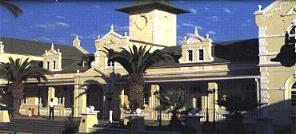 were
unsuitable.
were
unsuitable.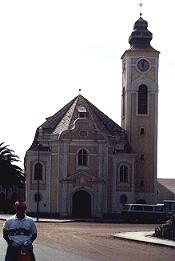
 design by Willy Sander - architect of
Windhoek's ''Three Castles''), was completed in 1901.
design by Willy Sander - architect of
Windhoek's ''Three Castles''), was completed in 1901.