Information about one of
the oldest Namibia's
National parks.
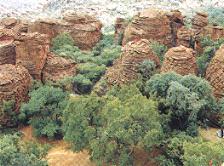
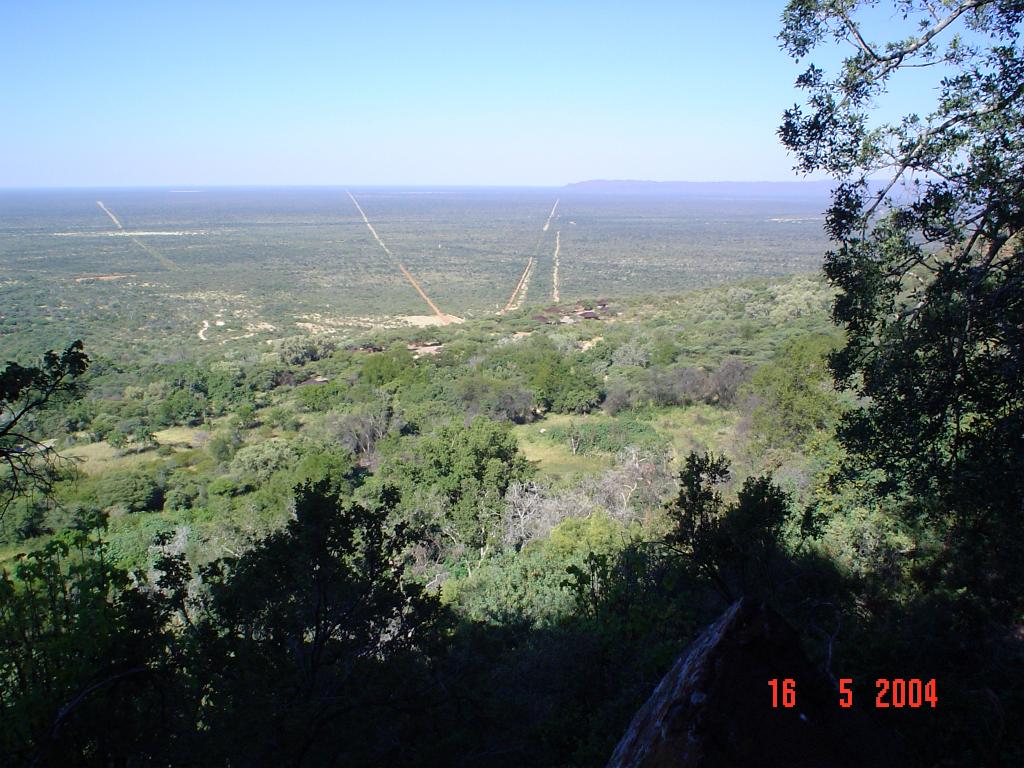
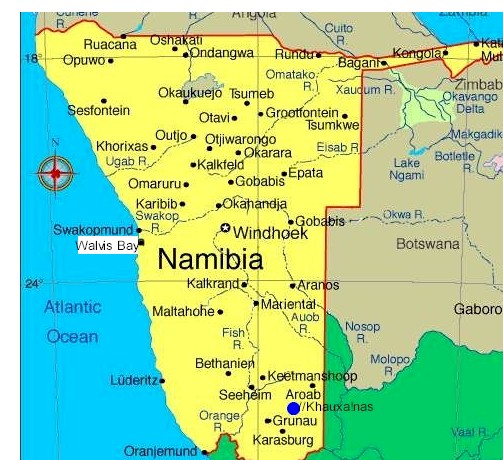
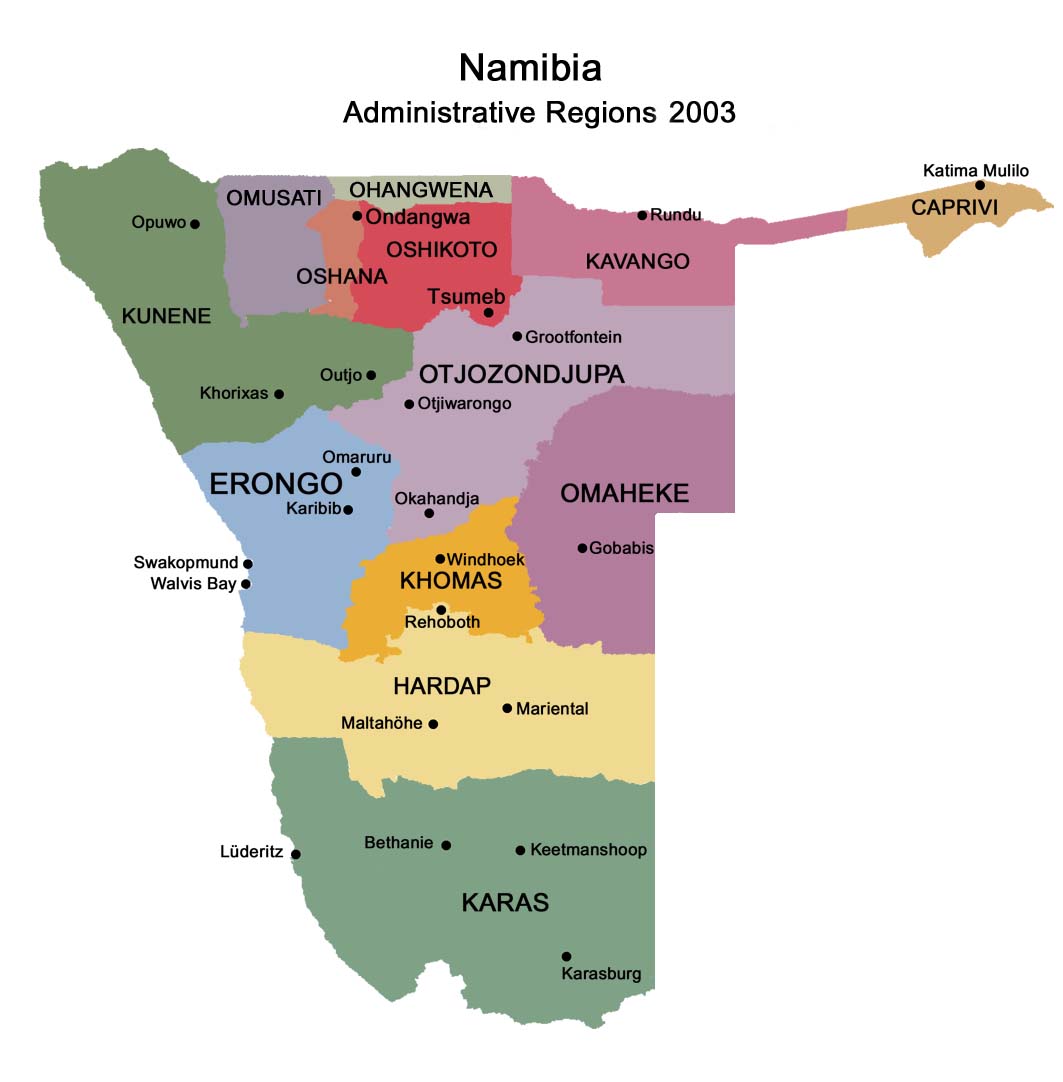
The Waterberg Park is located 280 km north of Windhoek. The mountain owes its name to the springs surfacing on its lower
slopes, and the lush vegetation that grows here contrasts sharply with the thorn
savannah of the surrounding plains. The plateau itself is one of the
most interesting geological sites in the country. Some features such as dinosaur tracks
and petrified dunes make it almost a must stop for travellers on the way further north.
One
of the reasons for establishing the park was to protect and resettling endangered species
(black and white rhinoceros, buffalo, roan and sable antelopes). It is also not unusual to
encounter leopards, rock dassie, klipspringer, tsessebe, wild dog, lesser bush babies and
cheetahs. The only Cape vulture colony in Namibia lives in the Karakuwisa
mountain on the western edge of the Waterberg plateau.
Waterberg Plateau National Park introduction
video:
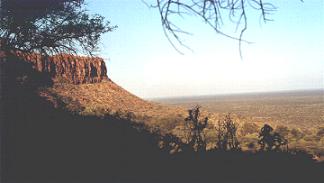
The plateau rises more than 200 metres above the surrounding plains with a width of
between 8 and 16 kilometres and a length of about 49 kilometres from south-west to
north-east. The average altitude of the plateau is between 1650 and 1700 meters above sea
level.
The area is also rich in a plant life. The total of approximately five hundred plants have
been recorded in and around the
park.
The geology of the plateau is as interesting as history of the area. The eroded
sedimentary rock which forms it was deposited during Karoo Age about 220 to 180 million
years ago.
A Rhenish mission station was established at the Waterberg in 1873, than later destroyed
during Nama/Herero wars and rebuilt again in 1891. During 1904 in time of Herero Uprising
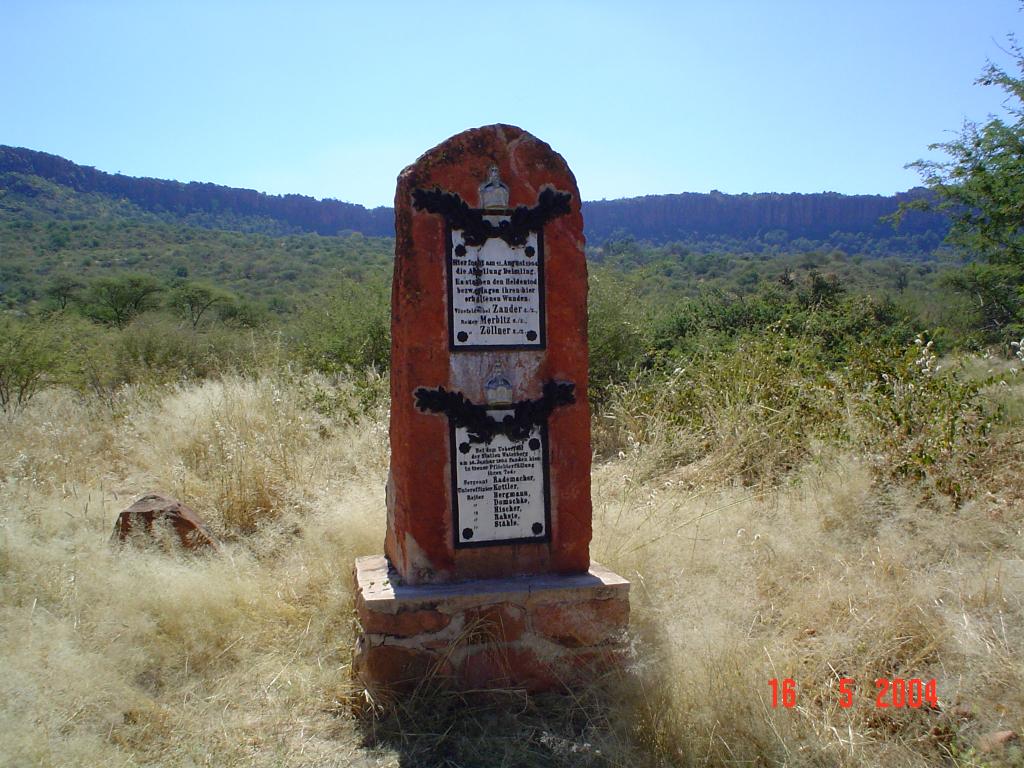
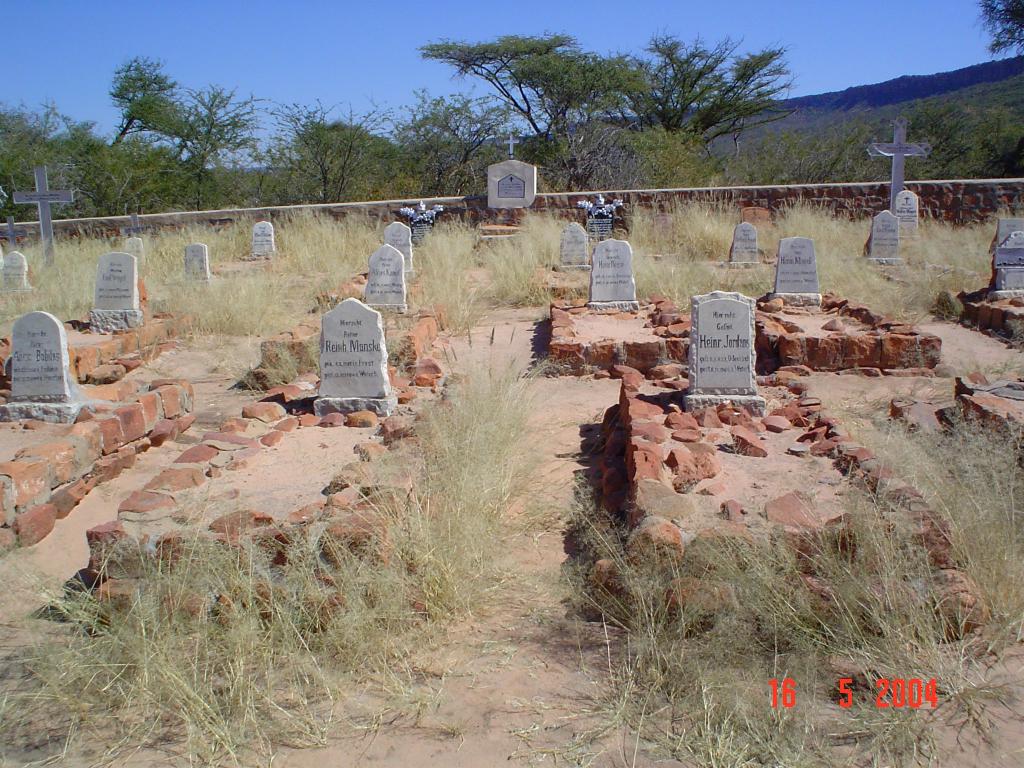
the battle between Hereros and German Colonial forces took place at the Waterberg. As a
reminder of this event a graveyard can be seen in the vicinity of the camp.
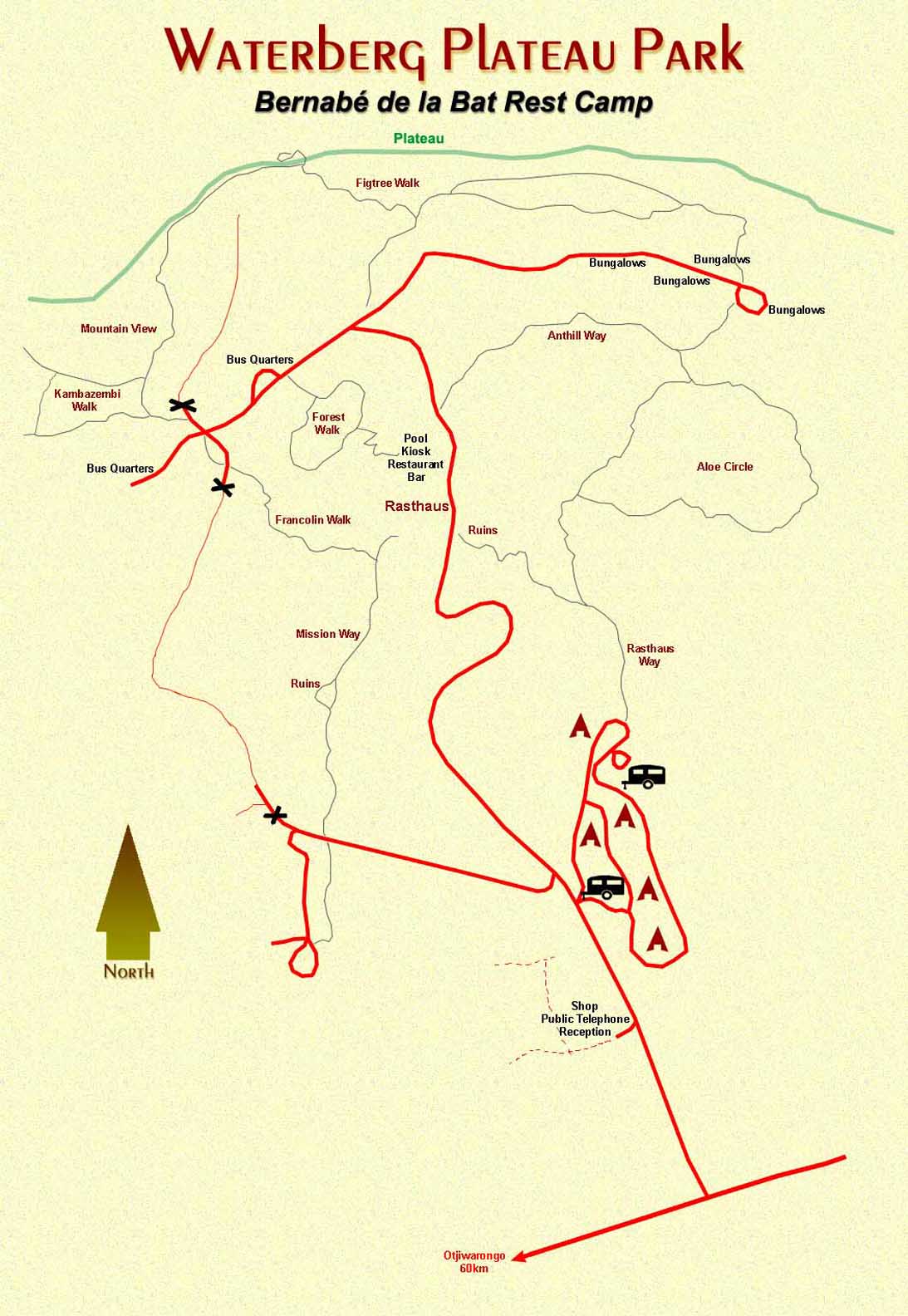
The rest camp can accommodate more than 200 people. There is a petrol station and a shop at the camp.
Camping sites are also available.
Unfortunately private vehicles are not allowed to drive to the plateau but regular
excursions are organized daily by park personnel.
Bernabe de la Bat Rest Camp. Nestling
amongst indigenous vegetation, this delightful rest camp was named after the
first director of Namibia's Department of Nature Conservation. The camp was
designed to blend with the surroundings, and during construction as little as
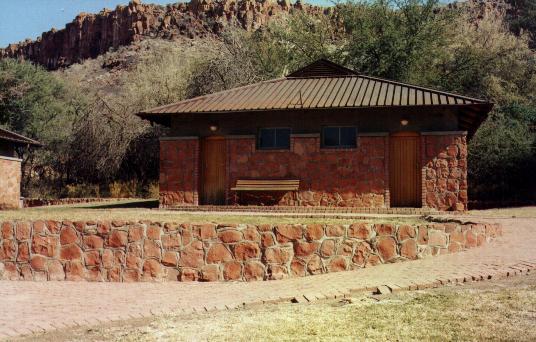
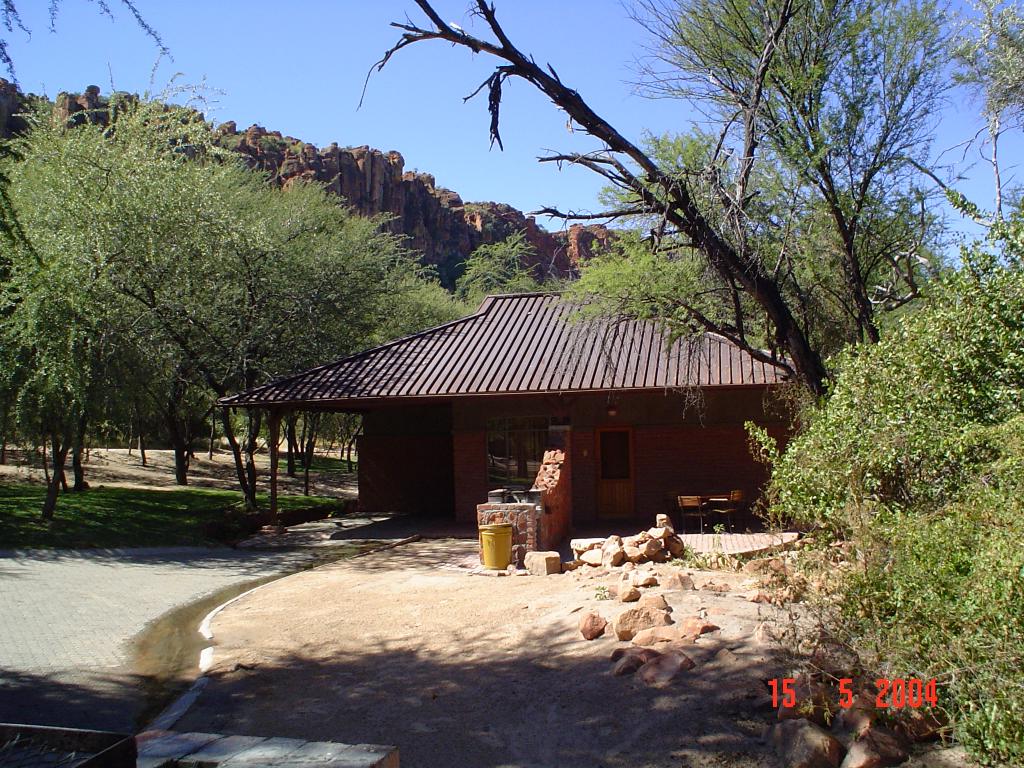
possible of the natural vegetation was disturbed. In addition, the reddish brown
sandstone bricks of the buildings and their copper-coloured roofs echo the
colour and texture of the cliffs overlooking the rest camp. Accommodation ranges
from four and three bed bungalows to deluxe rooms sleeping two people. Bungalows
are equipped with a hotplate, refrigerator and kettle, but no crockery, cutlery
or cooking utensils. There are also shaded camp sites with communal ablutions
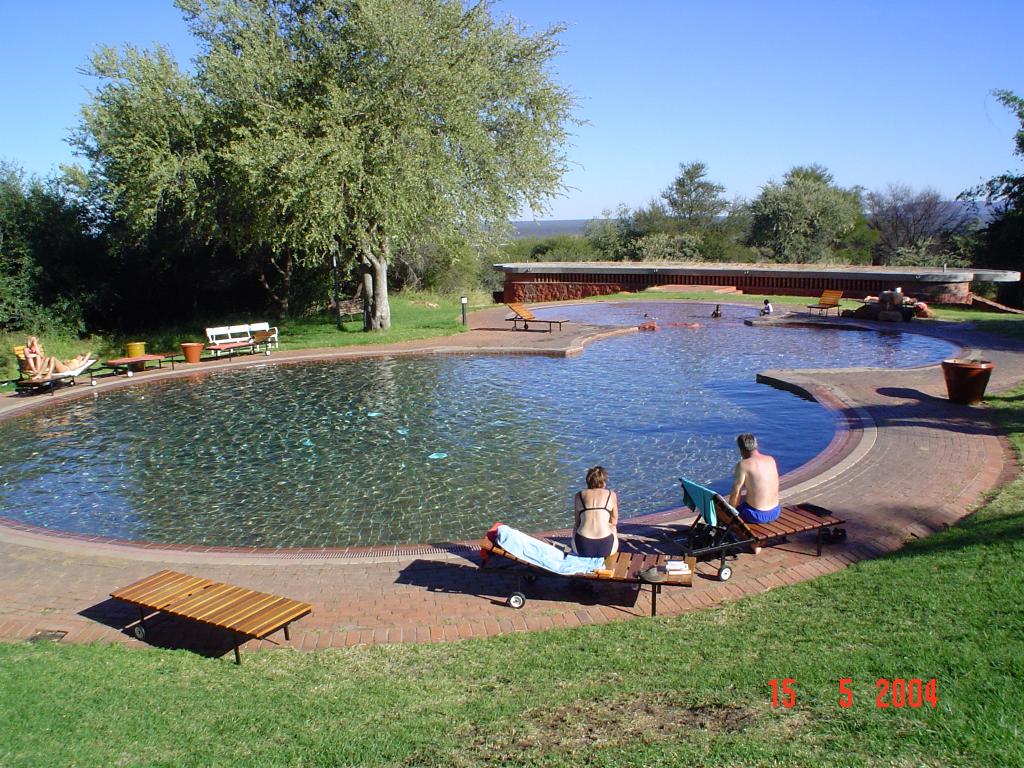
and field kitchens. Other amenities include a swimming pool with a superb view
of the cliffs, a restaurant, shop which stocks frozen meat, tinned goods and
curios, and a filling station where only petrol is sold.
Flora. One of the Waterberg's many interesting facets is its diversity of
flowering plants, trees
and shrubs. Enormous common cluster leaf figs form dense
canopies in the vicinity of the springs, where ferns create a verdant
undergrowth. Magnificent karee, lead wood and buffalo-thorn trees can also be
seen here. The broad-leaf woodlands of the sandy plateau are typical of the
sandveld of eastern and north-eastern parts of Namibia. There are also striking
silver cluster-leaf with its silver grey foliage, wild syringa and Kalahari
apple leaf. Among the rocky outcrops there are the weeping wattle, its striking
yellow flowers appearing from September to December, the lavender bush and the
laurel fig, which clings tenaciously to the rocks against which it grows. Adding
to the beauty of the rock faces are splashes of brightly coloured lichens, of
which there are over 140 species in the Waterberg.
Fauna. The park was proclaimed in 1972 as a
sanctuary for Namibia's declining eland population and as a breeding centre for
rare and endangered species. Among the game roaming on the plateau are black and
white rhino, buffalo, giraffe, roan, and sable. Other common antelopes include
kudu, impala, gemsbok, eland, klipspringer and steenbok. Predators are
represented in the park by leopard, cheetah, brown hyena, caracal and
black-backed jackal.
Waterberg old
German military cemetery dated back to 1904 Herero uprising:
While it is usually the larger animals that receive the most attention, the
environs of the Bernabe de la Bat Rest Camp are home to several delightful small
mammal species. The diminutive Damara Dik-Dik can sometimes be seen in and
around the rest camp, while lesser bush babies might reveal themselves at dusk.
Along the Forest Walk packs of banded mongoose are often encountered.
A Rhenish mission station was established at the Waterberg in 1873, destroyed
during Nama/Herero wars and rebuilt again in 1891. Unfortunately it was
abandoned in 1940-s.
Usage and entrance fees per day (payable on arrival or pre-booked): click here
Accommodation per night: on request
Unit type
Number of units
Daily rates per person
Single rate
Note
Premier Bush chalet 2 beds
8
-
-
Bed and breakfast maximum 2 adults
Family chalet 4 beds
4
-
-
Bed and breakfast maximum 4 adults
Bush chalet 4 beds
11
-
-
Bed and breakfast maximum 4 adults
Bush chalet 2 beds
12
-
-
Bed and breakfast maximum 2 adults
Double room 2 beds
34
-
-
Bed and breakfast maximum 2 adults
Camping
40
-
-
Maximum 8 persons per site
Accommodation only: children under the age of 6 stay free of
change, 6-12 years old pay 70%.
Provision for children will be made
upon arrival; however the booking must be made in advance.
Disabled access units available - please specify when booking
Shop, kiosk,
swimming pool, restaurant, fuel (no diesel). No banking facilities.
Conference
facilities (20 persons)
Flap chart, overhead projector, table/chairs and white screen. Rate: on request.
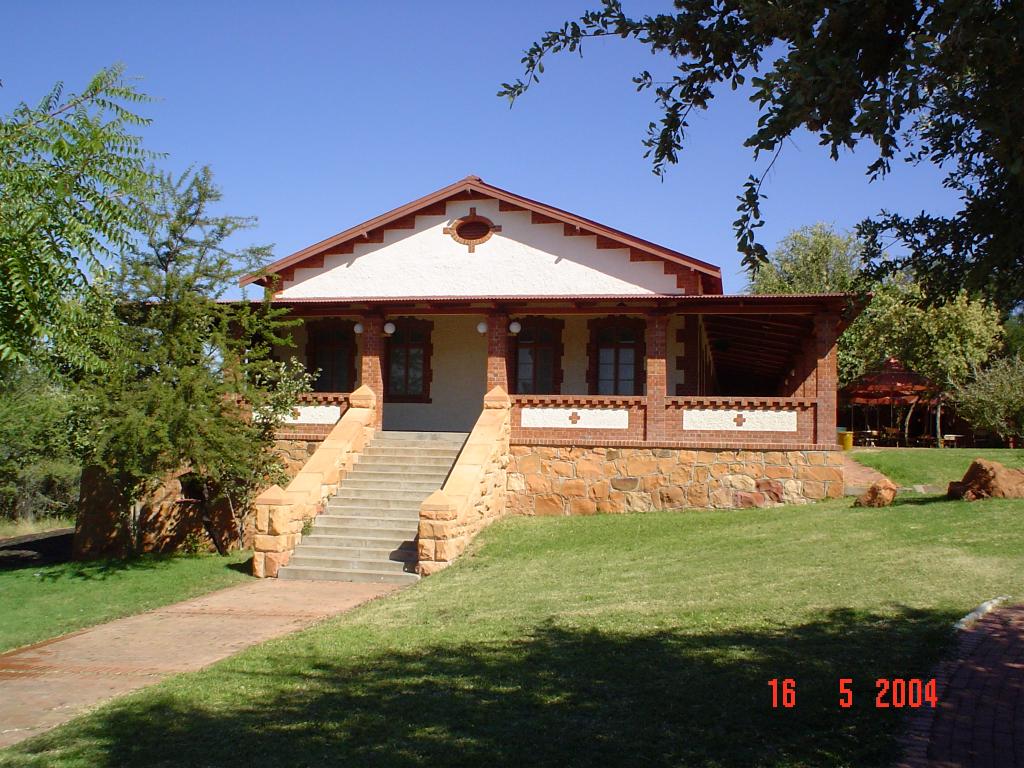
Restaurant (located
in the old German police station building)
Open: 7.00-8.30, 12.00-13.30, 19.00-21.00
Bar:
Open: 12.00-14.00, 18.00-22.00
Daily game drives to
Waterberg Plateau
Rates: on request
Departure times: 7.00 a.m. and 3.00 p.m. Duration: approximately 4 hours.
Waterberg wilderness trail
The Waterberg guided wilderness trail starts from the camp on every second, third and
fourth weekend of each month, from April to November. Hikers depart on Thursday and
arrive back on early Sunday afternoon. A group consists of 6 to 8 persons. Hikers have to
provide own food and sleeping bags. Rate: on request.
There is also unguided 50 kilometres long hiking trail which can be undertaken at own
risk. Open from April to November, depart every Wednesday from the resort office at 9
o'clock in the morning. The trail's duration is 4 days and it ends on Saturdays. Hikers
have to have all necessary equipment and food. Rate: on request. Minimum 6 persons.
There are few true undisturbed, ecologically-sound, natural areas remaining in the world today. Areas where animals and plants have been 'spared' and allowed to
flourish in their own right. Areas sheltered from the havoc wreaked elsewhere by man. Namibia however, is fortunate in having a number of areas such as this, one of the most spectacular of these
undoubtedly being the Wilderness area of the Waterberg Plateau Park.
Waterberg information
The Waterberg Plateau, towering some 200 meters above the surrounding landscape,
with sheer cliffs and fascinating rock formations, is one of the most
spectacular features of the northern region. Daily guided drives are offered to
the plateau, which is managed as a breeding area for rare and endangered
species, including black and white rhinoceros , disease-free buffalo, sable and
roan antelope. The natural
beauty of the area can also be explored on foot,
How to reach the resort (Directions from Windhoek)
From Windhoek, take the B1 through Okahandja (68 km) en route to Otjiwarongo
until you reach the C22 Okakarara turn off (161 km from Windhoek). Then continue
on for about 33 km until you reach the D2512 turn off to Waterberg. From there
you drive east for approximately 18km on the gravel road until you reach the
Waterberg Resort.
GPS Coordinates
20°30'51.74" S
17°14'45.34" E
Accommodation
The Waterberg Camp offers accommodation in comfortable premier bush chalets, two
and four bed bush chalets and double rooms, all nestled along the base of the
Waterberg plateau cliffs, amongst towering trees. the restaurant , bar and kiosk
are housed in the historic Rasthous, originally built in 1908 and used as a
police post for several years. A shop, Swimming pool and camping site are also
available.
8 Premier Chalets: 2 beds, 1 room; deluxe double chalet, with double bed,
en-suite bathroom, fridge and tea station as well as braai facilities.
4 Family Chalets: 4 beds, 2 rooms; with two en-suite bedrooms,
lounge area, kitchenette with fridge, tea station and breakfast table and
outside braai facilities.
11 Bush Chalets: 4 beds, 2 rooms; chalet with two bedrooms,
both en-suite, lounge area with breakfast table, fridge, tea station and braai
with seating area.
12 Bush Chalet 2 beds, 1 room; Double chalet with bathroom,
lounge area with breakfast table, fridge, tea station and braai with outside
lounging area.
Double Room 2 beds, 1 room; Comfortable double rooms with
en-suite bathroom, fridge and tea-station.
Camping Site demarcated shaded sites with 7 Ablution Blocks
all with showers and toilets;
2 Field Kitchens equipped with cooking areas
All camping sites are outfitted with braai facilities, power points and cold &
hot water.
Other Facilities: Swimming Pool, Restaurant, Bar and Kiosk,
Fuel Station
Check In and Check Out Times:
Check In time on day of arrival is 12h00 and Check out time on day of departure
is 10h00
Flood-lit Waterhole, guided morning and afternoon
Game Drives, Nature Walks within the camp, hiking trails.
Morning Nature Game Drive
The game drive departure at 06H15 in the morning for 4 Hours
Guest should be at the Reception area at 06H00
Booking should be done in advance with the Waterberg Resort.
Afternoon Nature Game Drive
The game drive departure at 15H30 in the afternoon for 4 hours
Guest should be at the Reception area at 15H15
Gate opens between 06H00 to 21h00
Waterberg Wilderness Trail – Guided
• 42 km trail
• Min.6 –Max. 8 people per group
• Open April – November, every 2nd ,3rd & 4TH weekend of each month only
• Hikers depart Thursday at 14H00 at the Onjoka Gate
• Hikers arrive Sunday afternoon at the Onjoka Gate
Waterberg Unguided Hiking Trail
• 50km trail
• Min.3 – max.10 people per group
• Open April – November only,
• Hikers depart every Wednesday at 09h00 from the Resort Office, return Saturday
• Completion: 4 days
• Trail at hikers own risk
HISTORY
The origin of Waterberg dates back some 180 - 200 million years ago, when desert conditions prevailed in southern Africa. Large portions of the subcontinent were covered by an up to 300m thick deposit of red dune sand. Over time, this sand solidified to form a hard red sandstone rock
known as Etjo Sandstone. During the past 100 million years, this sandstone has gradually been eroded away leaving behind only erosional relics which today form impressive mountain scenery.
In 1972, the Waterberg Plateau Park (41 000 ha) was proclaimed as a park for the purpose of breeding and maintaining populations of rare and endangered animal species in Namibia. (Since the proclamation of this area, many endangered species such as the white & black rhino,
buffalo, tsessebe, sable, and roan antelope have been successfully relocated to this region where their survival is now ensured.) A total of 18 000 ha of the park was set aside by the Directorate to be preserved as a wilderness area.
It is indeed a privilege to have the opportunity of spending time within a natural area such as the Waterberg wilderness, to appreciate the natural beauty and become involved in it's
tranquility. Trails offered by the Directorate parks and wildlife Management within this wilderness make it possible to experience and enjoy a venture such as this. The trail
To minimise the impact trails would unavoidably have on the fragile ecology of the area, no set trails have been laid out for people to follow, instead, groups will be led by a Nature Conservator with a sound knowledge of the Waterberg. The Nature Conservator will provide the group with information concerning the flora, fauna and geology of Waterberg and on conservation in general.
Visitors will pass through the dense, dry woodland savanna vegetation, pursuing natural routes such as game tracks, and canyons, between towering pillars of wind sculpted rock, and through dry water courses.
Highlights of the trails will undoubtedly be the chance of sighting leopard, finding roan drinking water from one of the many natural rock pools, or stalking a herd of sable antelope, while one can keep his/her mouth busy with wild berries.
For those with interests of a more botanical nature, perhaps one of the most distinguishing characteristics of the Waterberg is the vegetation. The
microclimate associated with the Waterberg has resulted in a dense, broad leafed deciduous vegetation type cover, which contrasts markedly with the thornbush savanna vegetation type of the plains below the plateau.
Within the woodland savanna wilderness, magnificent specimens of various interesting plant species, to be seen on the trails, are found to occur. Itinerary
- Trails are conducted on the second, third and fourth weekend of every month, from April to November.
- The trail begins on the Thursday afternoon and ends early Sunday afternoon. People who have booked for the trail must arrive at the Onjoka office to be let into the park between 14h00 and 16h00 on Thursday afternoon.
- Only one group (minimum 6 and maximum 8) will be taken on the trail each weekend.
- Place bookings must be made in advance. Payment may be made either at this booking office or at the Onjoka office at the start of the trail.
- Travelling time from Windhoek to Onjoka is approximately 5 hrs.
- All vehicles will be left at Onjoka from where a park staff will take the group, together with all their personal effects, in a four wheel drive vehicle to the base camp on the plateau.
- The distance covered during the trail each day will depend very much on the general fitness of the group, but will not exceed 15 km per day.
- Evenings will be spent peacefully around a campfire chatting and listening to the sounds of the wilderness.
- Early Sunday afternoon, when the camp ends, the group will be transported back down to Onjoka.
- Children under 12 years of age will not be permitted to participate in these trails.
What is provided
- Rock shelters and bunks
- Mattresses and pillows
- All cooking and eating utensils
- Fresh water
- Water bottles
- Rucksack for trails
- Firewood
- A flash toilet and washing facilities (cold water only)
- Basic first aid equipment (including snake bite serum) What to bring
- Food
- Comfortable clothes
- Good walking shoes
- Torch
- Sleeping bag
(Optional)
- Hat
- Binoculars
- Camera & films
- Insect repellent
- Plant & bird handbooks
- Sunblock cream & sunglasses
NB: No radios are permitted Reservations
(click for more information)
 park.
park.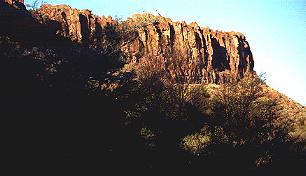 and shrubs. Enormous common cluster leaf figs form dense
canopies in the vicinity of the springs, where ferns create a verdant
undergrowth. Magnificent karee, lead wood and buffalo-thorn trees can also be
seen here. The broad-leaf woodlands of the sandy plateau are typical of the
sandveld of eastern and north-eastern parts of Namibia. There are also striking
silver cluster-leaf with its silver grey foliage, wild syringa and Kalahari
apple leaf. Among the rocky outcrops there are the weeping wattle, its striking
yellow flowers appearing from September to December, the lavender bush and the
laurel fig, which clings tenaciously to the rocks against which it grows. Adding
to the beauty of the rock faces are splashes of brightly coloured lichens, of
which there are over 140 species in the Waterberg.
and shrubs. Enormous common cluster leaf figs form dense
canopies in the vicinity of the springs, where ferns create a verdant
undergrowth. Magnificent karee, lead wood and buffalo-thorn trees can also be
seen here. The broad-leaf woodlands of the sandy plateau are typical of the
sandveld of eastern and north-eastern parts of Namibia. There are also striking
silver cluster-leaf with its silver grey foliage, wild syringa and Kalahari
apple leaf. Among the rocky outcrops there are the weeping wattle, its striking
yellow flowers appearing from September to December, the lavender bush and the
laurel fig, which clings tenaciously to the rocks against which it grows. Adding
to the beauty of the rock faces are splashes of brightly coloured lichens, of
which there are over 140 species in the Waterberg.